
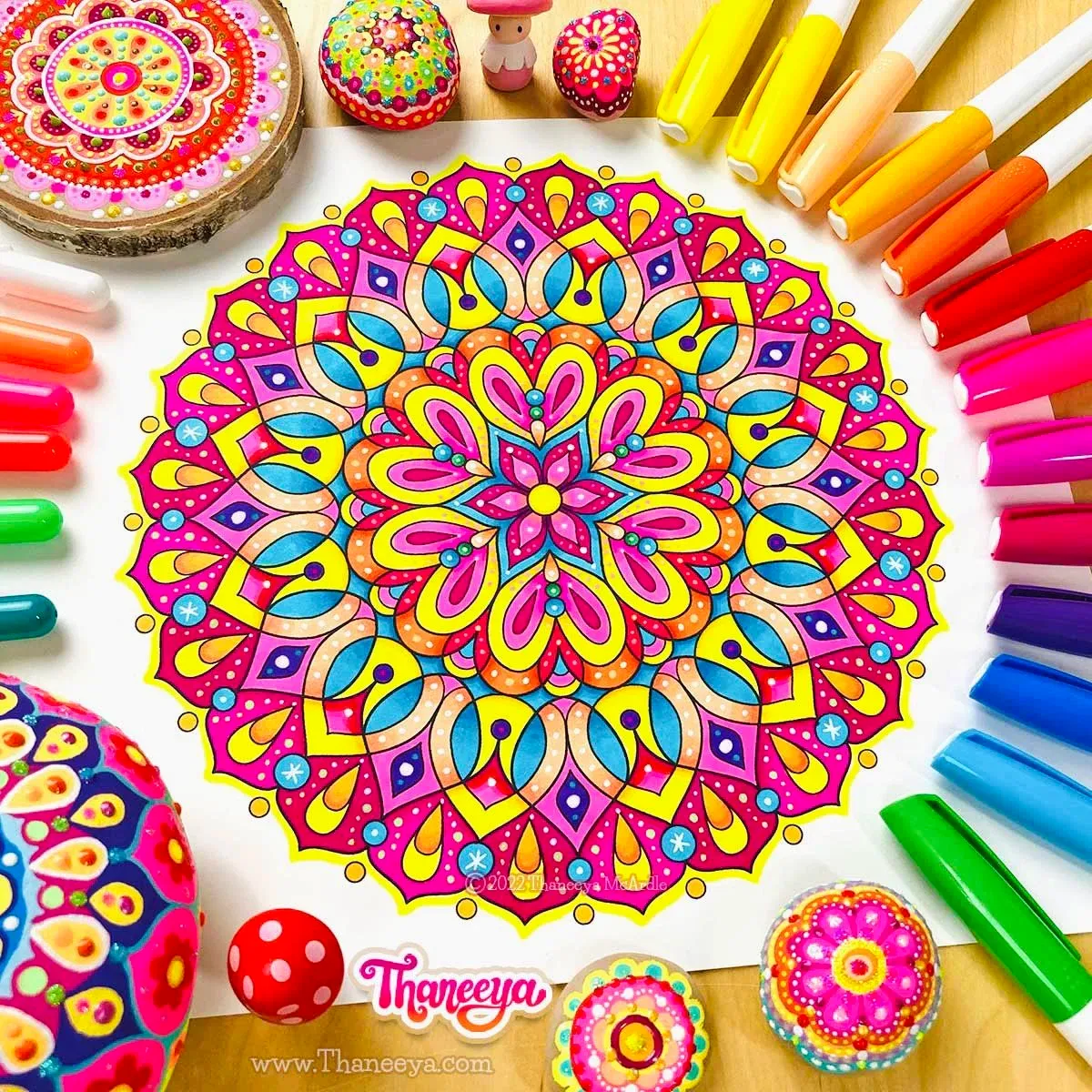
Mandala art coloring designs have moved from ancient spiritual temples into the living rooms of millions, providing a much-needed bridge between traditional meditation and modern creative expression. I remember the first time I sat down with a complex circular pattern, feeling the weight of a long work week on my shoulders. My mind was a chaotic storm of emails, deadlines, and social obligations. As I began to fill the outer petals with a deep indigo, I noticed something remarkable happening to my breathing. The rhythmic movement of the pencil across the paper acted as a metronome for my heart rate, slowing everything down until the only thing that existed was the tip of the pencil and the white space ahead.
The history of the mandala is rooted in the idea of “centering.” In Sanskrit, the word mandala translates to “circle,” but its meaning goes far deeper than a simple shape. It represents the universe and the idea that life is never-ending and everything is connected. When we engage with these patterns today, we are tapping into a design language that has been used for centuries to focus the mind and soul. This historical context provides a level of depth that many other coloring themes lack. It is not just about aesthetics; it is about engaging with a symbol of wholeness and cosmic harmony.
One of the most profound aspects of working with Mandala art coloring designs is the lack of a required starting point. While most art requires you to think about a composition from left to right or top to bottom, a mandala invites you to start wherever you feel a pull. Some people prefer to start in the very center, expanding their colors outward like a blooming flower. Others find it more grounding to start at the edge, working their way toward the core as if they are traveling inward toward their own center. This freedom of movement is a quiet form of rebellion against the rigid structures of our daily lives.
Psychologically, these intricate patterns work by engaging both the analytical and creative sides of the brain. The mathematical symmetry of the lines satisfies the left brain’s desire for order and logic. Meanwhile, the act of selecting colors and blending shades stimulates the right brain’s creative and intuitive functions. This rare synchronization leads to what psychologists call a “flow state.” In this state, you lose track of time, your self-consciousness vanishes, and you experience a sense of energized focus. It is a form of active mindfulness that doesn’t require you to sit in silence for hours.
The Psychological Power of Mandala art coloring designs
The therapeutic benefits of this practice are backed by significant research in the field of art therapy. For individuals struggling with anxiety, the structured nature of the circle provides a safe container for their emotions. Unlike a blank piece of paper, which can feel intimidating and overwhelming, a pre-drawn mandala offers a framework. It says, “The boundaries are already here; you just have to bring the life to it.” This lowering of the barrier to entry is essential for those whose mental energy is already depleted by stress or chronic illness.
I once spoke with a nurse named Sarah who worked in a high-intensity trauma unit. She described her home life as a constant battle to “turn off” the images and sounds of the hospital. She began using these designs as a ritualistic way to decompress after her shifts. She explained that the repetitive nature of the patterns allowed her brain to process the day without having to speak about it. For her, the colors represented emotions she couldn’t yet put into words. A page filled with fiery reds and oranges might represent a difficult day, while a soft blue and silver piece symbolized a successful recovery.
Moreover, the physical act of coloring helps to refine fine motor skills and hand-eye coordination. In an age where most of our hand movements are limited to swiping on glass or typing on plastic, the tactile feedback of lead on paper is vital. You feel the texture of the grain, the resistance of the wax, and the gradual layering of pigment. This sensory input grounds you in the physical world, acting as an anchor that prevents the mind from wandering into the “what-ifs” of the future or the regrets of the past. It is a total sensory immersion that demands your presence.
The choice of color in these designs also offers a unique window into our subconscious. Color psychology suggests that we often gravitates toward the hues we need most in the moment. If you find yourself reaching for vibrant yellows and greens, you might be seeking growth and a fresh start. If you are pulled toward deep purples and golds, you may be in a period of introspection or spiritual seeking. The finished mandala becomes a visual map of your emotional state at that specific moment in time, providing a beautiful record of your personal journey.
Choosing Materials for Mandala art coloring designs
To get the most out of your artistic sessions, the choice of materials is more important than you might initially think. While a basic set of school crayons will get the job done, investing in higher-quality tools can significantly enhance the experience. I usually recommend starting with a set of artist-grade colored pencils. These have a higher pigment-to-wax ratio, allowing for much smoother blending and layering. When you can create a seamless transition from a deep crimson to a pale blush, the mandala takes on a three-dimensional quality that is incredibly satisfying to look at.
The paper quality is another factor that shouldn’t be overlooked. Many budget coloring books use thin, porous paper that causes ink to bleed through and colors to look dull. If you are serious about your practice, look for books or printable pages that feature heavyweight, acid-free paper. This type of surface can handle multiple layers of color and even light washes of watercolor or alcohol markers without warping. The “tooth” of the paper—the tiny bumps on the surface—holds the pigment better, giving your finished work a professional, vibrant appearance that you’ll be proud to display.
Fine-liner pens are another excellent choice for those who enjoy the precision of Mandala art coloring designs. Because many of these patterns contain microscopic details, a traditional pencil might be too blunt to reach the corners. Fine-liners allow you to add tiny dots, intricate cross-hatching, or sharp borders that make the geometric shapes stand out. Many artists find that a combination of pencils for the larger areas and pens for the details creates the most dynamic results. This mix of mediums keeps the process interesting and allows for more experimentation.
Another expert tip is to consider your lighting environment. Many people try to color under harsh, cool-toned overhead lights, which can cause eye strain and distort how colors look. If possible, set up your coloring station near a window with plenty of natural light. If you are coloring at night, a warm-toned task lamp that mimics sunlight will help you see the nuances in your shading. Creating a comfortable, well-lit space is a way of honoring your creative time and ensuring that the activity remains a pleasure rather than a chore.
The social aspect of this hobby is also something that has grown tremendously in recent years. Online communities and local “coloring circles” allow people to share their finished works and exchange techniques. Seeing how ten different people interpret the exact same mandala is a fascinating lesson in human perspective. One person might see a sunburst, while another sees a snowflake or a complex machine. Sharing your work in these supportive environments can build a sense of community and provide inspiration when you’re feeling stuck on which color to pick next.
It is also worth mentioning the rise of digital coloring apps. While they lack the tactile sensation of physical paper, they offer an incredible level of accessibility. You can carry thousands of patterns in your pocket and experiment with infinite color combinations with a single tap. For those with limited mobility or those who travel frequently, digital mandalas provide a portable sanctuary. However, I always suggest that people try the physical version at least once, as the “unplugged” nature of traditional coloring is a significant part of its stress-relief potential.
For those who want to take their practice to the next level, creating your own mandalas from scratch is a rewarding challenge. You don’t need to be a professional artist; you just need a compass, a protractor, and a bit of patience. Starting with a single dot in the center and drawing concentric circles provides the skeleton of the design. From there, you can add repetitive shapes—petals, triangles, or swirls—to build the complexity. This process of creation followed by coloring offers a double dose of mindfulness that can be deeply fulfilling.
The versatility of Mandala art coloring designs means they can be integrated into many different areas of your life. I’ve seen people use their finished pages as unique gift wrap, as covers for personal journals, or even framed as wall art. There is something very special about decorating your home with a piece of art that you helped bring to life. Every time you walk past it, you are reminded of the hour of peace you spent creating it. It serves as a visual anchor, bringing a bit of that calm back into your busy day.
Many educators and parents are also finding that these designs are excellent tools for children. While adult versions are often more complex, the basic principles remain the same. For a child, coloring a mandala can help improve focus and provide a quiet activity that doesn’t involve a screen. It teaches them about symmetry, color theory, and the value of patience. It is a rare activity that can be enjoyed by a five-year-old and an eighty-five-year-old alike, making it a wonderful way to bridge the generational gap during family gatherings.
Interestingly, the meditative use of mandalas is even finding its way into corporate wellness programs. Some companies provide coloring stations in break rooms to help employees manage stress during the workday. Taking a ten-minute “micro-break” to color a small section of a mandala can reset the brain, making the employee more productive and less prone to burnout. It is a low-cost, high-impact way to prioritize mental health in the workplace, proving that the benefits of art are relevant in every setting.
If you find yourself getting frustrated while coloring, it’s important to remember that there are no “mistakes” in this art form. If you go outside the lines, make it part of the design. If you pick a color you don’t like, layer another one on top. The goal is the process, not the final product. The moment you start worrying about whether it looks “good enough” for social media is the moment the therapeutic benefit starts to fade. Give yourself permission to be messy, to be imperfect, and to simply play with the colors.
The sheer variety of styles available today ensures that you will never get bored. You can find mandalas that incorporate floral elements, animal silhouettes, Celtic knots, or even futuristic geometric fractals. This diversity allows you to choose a design that matches your current interest or mood. If you’re feeling a connection to nature, a botanical mandala might be the perfect choice. If you’re feeling a need for rigid structure, a mathematical geometric pattern might be more satisfying. The world of Mandala art coloring designs is virtually limitless.
I have found that setting a specific intention before starting a session can deepen the experience. You might say to yourself, “With this page, I am letting go of my worries about my project.” Or perhaps, “I am coloring this to invite more joy into my week.” As you fill in the spaces, keep that intention in the back of your mind. It transforms the act of coloring into a focused ritual, similar to how traditional monks would create sand mandalas while chanting prayers. It adds a spiritual dimension to your hobby that can be incredibly powerful.
When you finish a particularly difficult design, take a moment to sit with it before moving on to the next thing. Look at how all the separate colors and shapes have come together to create a unified whole. This reflection is a metaphor for our own lives—we are made up of many different experiences, emotions, and moments, some bright and some dark, but they all combine to make us who we are. This sense of completion and wholeness is the ultimate gift that Mandala art coloring designs provide to the practitioner.
It is also helpful to keep a “color journal” alongside your coloring book. You can jot down a few sentences about how you were feeling when you started a page and how you felt when you finished. Over time, you’ll see patterns emerge. You might notice that you always choose greens when you’re feeling tired, or that you tend to finish pages much faster when you’re feeling inspired. This self-reflection turns a simple hobby into a tool for self-discovery and emotional intelligence, helping you understand your own inner landscape more clearly.
For those dealing with chronic pain, art has long been recognized as a valuable distraction technique. By focusing intensely on the minute details of a pattern, the brain’s pain signals can actually be dampened. It doesn’t cure the underlying condition, but it provides a much-needed mental break from the physical discomfort. It gives the individual a sense of agency and accomplishment at a time when they might feel their body is failing them. The finished page is a testament to their resilience and their ability to find beauty even in difficult times.
As you continue your journey, you may find that your style evolves. You might start out with simple color-blocking and eventually move into advanced techniques like burnishing, stippling, or using white gel pens to add highlights. This growth is part of the fun. Every new page is an opportunity to learn something new about your materials and yourself. There is no finish line in the world of art; there is only the next circle, the next color, and the next moment of peace.
The beauty of the mandala is that it is both a personal and a universal symbol. It speaks to our shared human desire for order, beauty, and connection. In a world that often feels fragmented and chaotic, the circle remains a symbol of hope and unity. Whether you spend five minutes or five hours with your colored pencils, you are contributing to a legacy of creativity that stretches back to the beginning of human history. So, find a design that speaks to you, settle into a comfortable chair, and let the colors lead you home to yourself.
Beyond the mental and emotional perks, there is a simple joy in the act of creation that we often lose as adults. We are so focused on being productive and efficient that we forget how to play. Mandala art coloring designs give us permission to be unproductive in the best possible way. They remind us that our value is not just in what we produce for others, but in the peace we cultivate for ourselves. It is a radical act of self-care in a fast-paced world, and it is a gift that is available to everyone, regardless of artistic talent or experience.
As you close your book at the end of a session, take that feeling of calm with you into the rest of your day. The focus you practiced while staying within those intricate lines can be applied to your work, your relationships, and your challenges. You have proven to yourself that you can be still, that you can be patient, and that you can create something beautiful from nothing. That is the true power of the mandala, and it is a power that stays with you long after the colors have dried and the pencils have been put away.
Read also :-