
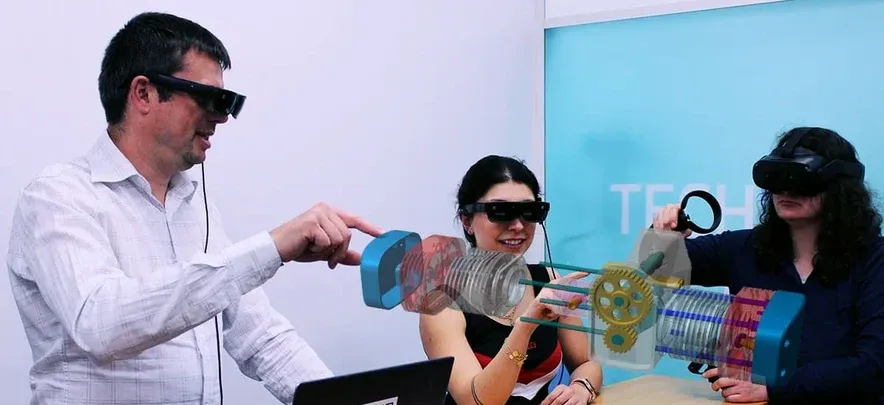
Mixed reality workspaces are rapidly reshaping how professionals collaborate, design, and solve problems across industries. What once felt like science fiction—digital objects blending seamlessly into physical environments—is now entering boardrooms, design studios, classrooms, and remote offices.
Imagine wearing a lightweight headset and seeing your desk expand into multiple floating screens. Your colleague appears as a life-sized holographic avatar, standing beside a 3D model you are both editing in real time. That is not a distant dream. It is the practical direction modern work environments are heading.
As hybrid work models become permanent for many organizations, mixed reality workspaces are emerging as a powerful bridge between physical presence and digital flexibility.
What Are Mixed Reality Workspaces?
Mixed reality workspaces combine physical surroundings with interactive digital elements through advanced hardware and software.
Unlike virtual reality, which fully immerses users in a simulated environment, mixed reality blends the real and virtual worlds. Users can see their physical space while interacting with digital objects anchored within it.
This integration allows employees to collaborate naturally while benefiting from digital tools layered into their environment.
Mixed reality workspaces are designed to enhance productivity, communication, and visualization without isolating users from their physical surroundings.
Why Mixed Reality Workspaces Matter in Today’s Hybrid World
The global shift toward hybrid and remote work has exposed limitations in traditional digital tools. Video calls, shared documents, and chat platforms are effective but lack spatial depth and immersive collaboration.
Mixed reality workspaces offer something more intuitive. Instead of staring at flat screens, professionals can manipulate 3D prototypes, analyze complex data visualizations, and hold immersive team meetings.
For distributed teams, this level of interaction fosters a stronger sense of presence. Participants feel engaged rather than detached.
In industries where design and spatial awareness are critical, mixed reality workspaces can dramatically improve efficiency and clarity.
The Technology Behind Mixed Reality Workspaces
The foundation of mixed reality workspaces lies in advanced hardware such as head-mounted displays and spatial computing devices.
These systems use cameras, sensors, and depth mapping to understand the physical environment. Digital objects are then placed within that environment in a stable, interactive way.
Powerful processors render high-resolution graphics while tracking hand gestures, voice commands, and eye movements.
Cloud-based collaboration platforms enable multiple users to access shared virtual content simultaneously.
The combination of hardware precision and software intelligence makes mixed reality workspaces both immersive and functional.
Real-World Applications of Mixed Reality Workspaces
In architecture and construction, teams can visualize building designs at full scale before breaking ground. Engineers walk around virtual structures placed inside real rooms, identifying potential flaws early in the process.
In healthcare, medical professionals use mixed reality simulations for training and surgical planning. Complex procedures can be visualized in 3D with real-time adjustments.
Manufacturing companies employ mixed reality workspaces for equipment maintenance and employee training. Digital overlays guide technicians step by step, reducing errors.
Even corporate offices use them for brainstorming sessions, allowing participants to manipulate floating charts and diagrams collaboratively.
These practical use cases demonstrate that mixed reality workspaces are not theoretical concepts but operational tools.
Benefits of Mixed Reality Workspaces for Collaboration
Collaboration becomes more intuitive when digital content feels physically present.
In a mixed reality meeting, participants can stand around a shared 3D object as if it were on a real table. This spatial interaction enhances understanding.
Non-verbal cues, such as gestures and positioning, add depth to communication.
Mixed reality workspaces also reduce reliance on static presentations. Instead of slides, teams explore interactive environments together.
This dynamic approach improves engagement and reduces miscommunication.
Mixed Reality Workspaces and Productivity
Productivity often depends on minimizing friction. Traditional setups require switching between multiple windows and devices.
Mixed reality workspaces can expand digital screens beyond physical monitor limits. Users arrange virtual displays anywhere within their field of view.
This flexible setup reduces clutter and allows multitasking in a more natural way.
For knowledge workers handling complex data, spatial organization enhances focus and efficiency.
As a result, many professionals report increased immersion and sustained concentration in mixed reality environments.
Overcoming Challenges in Mixed Reality Workspaces
Despite their promise, mixed reality workspaces face adoption barriers.
Cost remains a concern for smaller organizations. Advanced headsets and supporting infrastructure require investment.
User comfort is another factor. Extended use can cause fatigue if hardware is not ergonomically optimized.
Data security and privacy must also be addressed, especially when handling sensitive information in shared digital environments.
Organizations implementing mixed reality workspaces should prioritize training, security protocols, and gradual integration strategies.
Mixed Reality Workspaces in Education and Training
Educational institutions are exploring immersive learning through mixed reality workspaces.
Students can dissect virtual models, explore historical simulations, or collaborate on engineering prototypes.
Interactive environments promote active participation rather than passive listening.
In corporate training, new employees can practice real-world scenarios safely within controlled simulations.
The experiential nature of mixed reality enhances knowledge retention and skill development.
Industry Leaders Driving Mixed Reality Workspaces
Technology companies are investing heavily in spatial computing research.
Advancements in lightweight hardware and cloud-based rendering are accelerating adoption.
As competition increases, costs are gradually decreasing, making solutions more accessible.
Partnerships between hardware manufacturers and enterprise software providers are shaping comprehensive ecosystems for mixed reality workspaces.
This collaborative innovation ensures continuous refinement and broader industry acceptance.
The Human Experience in Mixed Reality Workspaces
Beyond technology, the human element is central.
Professionals often describe their first experience in mixed reality as transformative. Seeing digital content integrated seamlessly into physical space creates a sense of possibility.
The ability to interact naturally with virtual objects reduces cognitive strain compared to traditional interfaces.
Mixed reality workspaces encourage creativity by removing physical limitations of screen size and workspace boundaries.
This blend of physical comfort and digital flexibility enhances both morale and performance.
Security and Ethical Considerations
As mixed reality workspaces become more prevalent, ethical questions arise.
How should biometric data collected by headsets be stored and protected?
What guidelines ensure respectful behavior within shared virtual environments?
Organizations must establish transparent policies to address these concerns.
Clear governance frameworks build trust and encourage responsible use.
The Future of Mixed Reality Workspaces
The trajectory of innovation suggests that mixed reality workspaces will become lighter, faster, and more integrated into daily workflows.
Advances in artificial intelligence may enable intelligent virtual assistants that operate within spatial environments.
Remote collaboration could feel nearly indistinguishable from in-person interaction.
As hardware becomes more affordable and software ecosystems mature, adoption will likely expand across industries.
Mixed reality workspaces are not merely tools but evolving environments shaping the next phase of digital transformation.
Why Organizations Are Investing in Mixed Reality Workspaces
Forward-thinking companies recognize the competitive advantage offered by immersive collaboration.
Enhanced visualization reduces costly errors in design and manufacturing.
Improved engagement strengthens remote team cohesion.
Innovative work environments attract top talent seeking cutting-edge experiences.
Mixed reality workspaces represent a strategic investment in productivity and innovation.
Read also:-