
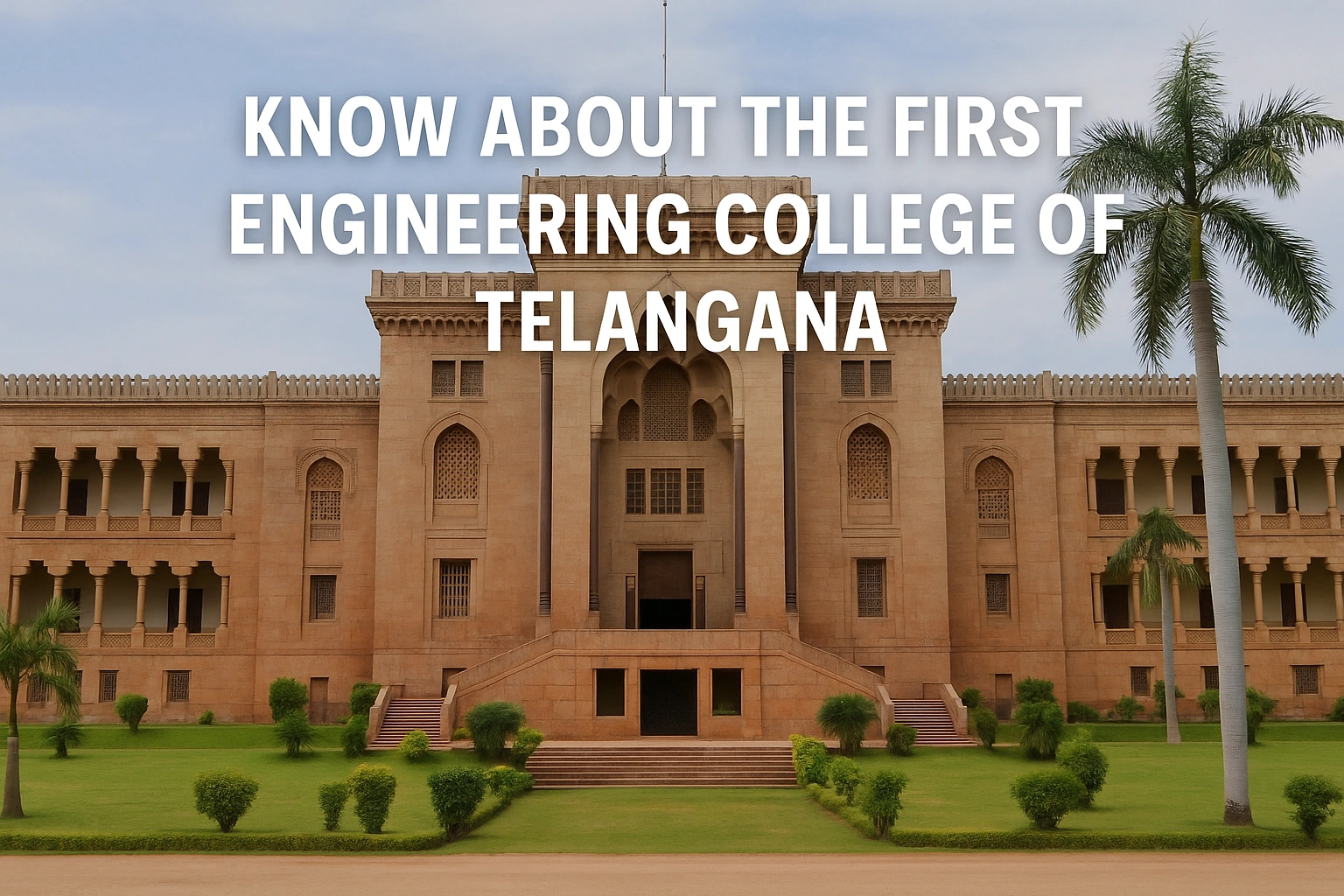
In the rich educational landscape of India, Telangana holds a unique place, especially in the domain of technical education. At the heart of this journey lies Osmania University College of Engineering, Hyderabad—widely recognized as the first engineering college of Telangana. With a legacy stretching back to the pre-independence era, this historic institution laid the foundation for generations of engineers, innovators, and visionaries who have shaped not only the region but also global industries.
Let’s take a deep dive into the heritage, contributions, and ongoing impact of this premier institution.
Genesis of Technical Education in Telangana
Before Telangana became a separate state in 2014, it was part of the undivided Andhra Pradesh. However, long before state formation debates, the region was already home to one of India’s earliest engineering colleges—Osmania University College of Engineering (OUCE), established in 1929 under the Hyderabad State governed by the Nizam.
This makes OUCE not only the first engineering college in Telangana but also one of the oldest and most respected engineering colleges in India. It began with just two branches—civil and mechanical engineering—and has since evolved into a modern technical hub offering a wide array of engineering disciplines.
Historical Significance: Engineering Vision Under the Nizams
Founded under the patronage of Mir Osman Ali Khan, the last Nizam of Hyderabad, the Osmania University College of Engineering was envisioned to serve the technical needs of the Hyderabad State and create a self-sufficient cadre of engineers.
The Nizam’s foresight in supporting education, particularly technical education, was exceptional for that time. By launching a full-fledged engineering institution, he not only empowered his subjects but also laid the groundwork for Hyderabad’s eventual transformation into a major tech and industrial center.
Key Historical Highlights:
-
1929: Inception with Civil and Mechanical Engineering disciplines.
-
1939: Gained affiliation with Osmania University.
-
1947: Post-Independence, the college adapted to national educational reforms.
-
1960s-70s: Expansion to include Electrical, Electronics, and Computer Science.
Architectural Marvel: The Heritage Building
The OUCE campus, located on the banks of the Musi River, is more than just a center for learning—it’s also an architectural landmark. The main building, constructed in the Indo-Saracenic style, reflects a fusion of Islamic, Hindu, and Gothic design elements. Recognized for its domes, arches, and imposing façade, it has become symbolic of Hyderabad’s unique cultural synthesis.
Visitors and students alike are often awed by the grandeur of the campus—proof that the Nizam envisioned education as both a necessity and a noble pursuit.
Courses and Departments: A Hub of Diverse Engineering Education
From its humble beginnings, OUCE now boasts a comprehensive range of engineering disciplines, including:
-
Civil Engineering
-
Mechanical Engineering
-
Electrical and Electronics Engineering
-
Computer Science and Engineering
-
Electronics and Communication Engineering
-
Artificial Intelligence and Machine Learning (recent addition)
-
Information Technology
Each department is staffed with experienced faculty, cutting-edge labs, and industry collaborations that prepare students for both academic and practical challenges.
Alumni Impact: From Local Legends to Global Leaders
Over the decades, OUCE has produced thousands of engineers who’ve gone on to make significant contributions across industries. Alumni have occupied top positions in:
-
Public sector units like BHEL, NTPC, DRDO, and ISRO
-
Private giants such as Microsoft, Google, Infosys, and TCS
-
International universities and research labs
-
Government services including IAS, IES, and IPS
This alumni network not only enhances the college’s reputation but also supports current students through mentorship, funding, and placement opportunities.
Research and Innovation: Pioneering Work from Telangana
OUCE is home to several centers of research excellence, including in structural engineering, power systems, and computer algorithms. The college is a participant in multiple Government of India-funded research projects and collaborates with international universities.
It also encourages undergraduate and postgraduate students to participate in national technical symposiums, paper presentations, hackathons, and startup initiatives.
Placements and Industry Collaborations
The college’s placement cell has built strong relationships with both Indian and global firms. Every year, top companies recruit OUCE students, especially in domains like:
-
Software development
-
Data analysis
-
Infrastructure and civil planning
-
Power systems and renewable energy
-
Core mechanical design and manufacturing
Placement statistics from the past five years have consistently shown that OUCE students are in high demand due to their robust technical foundation and problem-solving mindset.
Cultural & Student Life: Balancing Tech with Talent
While engineering may be its cornerstone, OUCE has a rich tradition of student engagement beyond the classroom. From technical fests like “Aakruti” to cultural events like “Sanskriti”, students find ample opportunities to develop soft skills, leadership abilities, and social awareness.
Student-run clubs focus on robotics, literature, entrepreneurship, NSS, sports, and environmental awareness. The environment is vibrant, competitive, and inclusive.
Role in Telangana’s Development
OUCE has not only educated engineers—it has built the infrastructure of Telangana in a metaphorical and literal sense. Its alumni have helped design roads, bridges, power grids, irrigation systems, and IT solutions that power the region.
As Telangana evolves into an innovation-first, startup-driven economy, OUCE continues to serve as a key contributor by producing agile, tech-savvy professionals ready to meet modern challenges.
Read More: https// decoratoradvice.com
Challenges and Future Outlook
Like many heritage institutions, OUCE also faces challenges in balancing legacy with modernization. Key areas of focus include:
-
Infrastructure Upgrade: Adapting century-old buildings for modern needs.
-
Digital Education: Integrating AI, IoT, and Industry 4.0 tools into the curriculum.
-
Global Collaborations: Partnering with international tech institutions and research centers.
-
Startup Support: Encouraging innovation through incubation and funding.
Telangana’s state government and Osmania University have recognized the need for investment and are working to ensure that OUCE retains its top-tier status for the next century.
Why It Still Matters: Pride of Telangana
In a state now known for its IT parks, biotech hubs, and world-class research institutions, the story of OUCE remains deeply significant. It’s a reminder that Telangana’s journey toward technical excellence began much earlier—thanks to a visionary Nizam, dedicated educators, and ambitious students.
For aspiring engineers, choosing OUCE is not just about academics—it’s about becoming part of a living legacy.
Conclusion
The first engineering college of Telangana, Osmania University College of Engineering, is far more than a historical footnote. It is a living, evolving symbol of Telangana’s commitment to knowledge, innovation, and self-reliance.
By preserving its heritage while embracing the future, OUCE stands tall as a beacon for the region’s youth—proving that great things can be built with vision, discipline, and the courage to lead.
Read More: decoratoradvice .com home
FAQs
1. When was the first engineering college in Telangana established?
Osmania University College of Engineering was established in 1929 under the patronage of the Nizam of Hyderabad.
2. What courses does OUCE offer today?
OUCE offers undergraduate and postgraduate programs in civil, mechanical, electrical, computer science, electronics, and new-age fields like AI and ML.
3. Is the college still affiliated with Osmania University?
Yes, OUCE remains an integral part of Osmania University and continues to operate under its academic framework.
Also Visit: